
ODM or OEM Jewelry Manufacturing for a First Run
A first run is a bet on shapes, and the development model decides how much of that bet is spent before anything sells. OEM means the brand brings finished CAD; ODM means the factory develops the concept from references. The published timings are identical either way, 48 hours for CAD and 25–30 days for a master sample, so the real difference is who carries the design work and where the intellectual property sits.
Key takeaways
- Both models share the same clock: 48 hours of CAD, 25–30 days of sampling, 21–28 days of production.
- Per-design floors are 50 pieces for silver, 100 for brass and 100+ for stainless steel.
- Four plating finishes across two designs create eight SKUs, not two.
- A first run of two silver designs in two finishes commits 2 × 2 × 50 = 200 pieces.
Two models, one clock
OEM is the shorter relationship. The buyer supplies a technical drawing or a CAD file, the factory quotes it, samples it and produces it. The published description is "You design, we produce," and the IP stays with the buyer.
ODM starts further back. The brief is a set of references, a mood board or a single sample, and the supplier turns that direction into a production-ready design. The published description is "You inspire, we create," and co-created collections are kept exclusive to the brand.
Neither model is faster in the factory. Both sit inside the same OEM/ODM flow and pass through CAD at under 48 hours and master sampling at 25–30 days. What changes is the work before CAD: in OEM that work happens in the buyer's studio, and in ODM it happens inside the supplier's development team.
For a first run, the honest question is whether the brand can hand over a file that is ready to cut. If it cannot, OEM will stall at the first review, and the schedule will slip by exactly the time it takes to finish the drawing.
The first run is sized by material, not by ambition
The floor applies to each design separately. A silver style opens at 50 pieces, a brass style at 100, and a stainless style at 100 or more. A brand that wants six designs in silver commits 300 pieces before any finish is added.
That number is usually larger than a first season needs. A tighter plan is two or three designs, each tested in one finish, with the reorder carrying the designs that sell.
Material also sets the finish route. Silver and brass are electroplated with multi-layer gold or rhodium and can take an anti-tarnish e-coating. Stainless is coated by PVD vacuum deposition, which is why colour on stainless behaves like a separate run.
| First-run shape | Arithmetic | Pieces |
|---|---|---|
| Two silver designs, one finish | 2 × 50 | 100 |
| Two silver designs, two finishes | 2 × 2 × 50 | 200 |
| Three brass designs, one finish | 3 × 100 | 300 |
| One stainless design, two colours | 2 × 100 | 200 |
Read the rows as a menu of risk. The first row tests two shapes for 100 pieces. The second tests the same two shapes in two finishes for twice the stock, and the extra 100 pieces buy information about colour rather than silhouette.
Plating turns one design into several SKUs
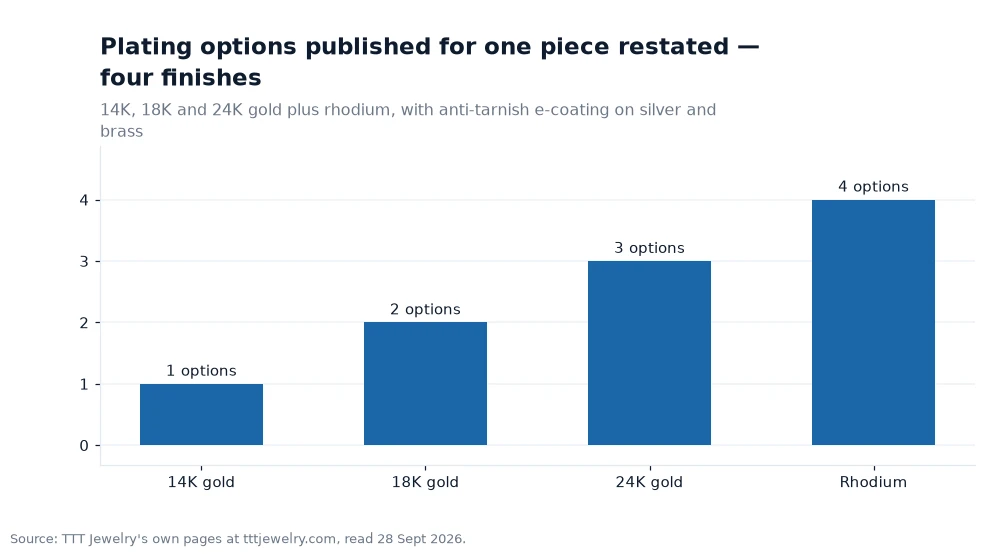
Four finishes are published: 14K gold, 18K gold, 24K gold and rhodium. On silver and brass they are applied as multi-layer electroplating, with an anti-tarnish e-coating on top to slow discolouration.
Each finish is a separate run. The piece is racked, cleaned, plated and inspected as a batch, so a second colour is not a variant added at packing. It is a second pass through the line.
That is why finish decisions belong at CAD, not at the sample review. Deciding between 14K and 18K after the sample arrives means a second sample or a second run, and either one costs calendar.
Stainless buyers face the same logic with PVD. A stainless steel jewelry manufacturer will treat each colour as a chamber run, so two colours on one design is two runs at the published 100+ floor.
Controls to ask for on a first order
A first order is also the moment to check that the supplier can document what it claims. ISO 9001:2015 covers quality management across production stages; BSCI covers labour and social audit; REACH and CA Prop 65 compliance cover the material and the plating.
Ask for the scope of each. A quality certificate that covers assembly but not casting is narrower than it sounds, and a compliance statement should name lead, cadmium and nickel rather than say "compliant" without a list.
Confidentiality is the other control. A 100% NDA and 100% exclusivity mean the moulds, CAD and collection are not resold or shown, which matters most on an ODM first run where the factory helped create the shapes. A brand paying for development is buying a range that should not appear in another catalogue six months later.
A custom OEM jewelry factory that publishes its process steps makes this easier to audit, because each claim maps to a stage that can be checked rather than to a brochure line.
Worked example
A brand plans two silver designs and wants to offer each in 14K gold and rhodium. The commitment is 2 designs × 2 finishes × 50 pieces = 200 pieces, which is eight SKUs at 25 pieces each.
The same two designs in one finish would be 2 × 50 = 100 pieces, so the second finish adds 100 units and four SKUs. If the brand switched to brass, the floor doubles: 2 × 2 × 100 = 400 pieces, which is 200 more than the silver version.
The calendar is unchanged by material. CAD at 2 days plus sampling at 25–30 days plus production at 21–28 days gives 48–60 days, or 6.9–8.6 weeks. Four finishes on one design would be 4 × 50 = 200 pieces in silver and four separate plating passes.
Now compare the information bought. The first 100 pieces test two silhouettes; the second 100 test whether a second colour earns its shelf space. A brand that can only fund one test should fund the silhouette, because a shape that does not sell cannot be rescued by a finish.
Frequently asked questions
Should a first run be OEM or ODM?
It depends on who holds the design. OEM suits a brand with finished CAD and clear ownership of the IP, while ODM suits a brand that needs the concept developed and wants the collection kept exclusive.
What is the smallest viable first order?
The lowest published floor is 50 pieces per design in 925 sterling silver, before finish variants are counted; brass starts at 100 and stainless steel at 100+.
Does a finish variant count as a new design?
It is not a new design, but it is a separate production run, so the per-design minimum applies to each finish and the piece count multiplies.
Choosing the model before the metal
Decide who owns the drawing first, because that answer sets the schedule, the IP terms and the amount of development the factory has to absorb.
Then size the run against the floor for the chosen material, and count finishes as separate runs rather than free variants. The TTT Jewelry page publishes both the floors and the windows used here, which makes the arithmetic checkable before a quote is requested.
A first run does not need to be large. It needs to be legible: two or three shapes, one or two finishes, and a reorder plan for whatever sells.
Source note: figures come from the manufacturer's own website (tttjewelry.com), read 28 Sept 2026.[1]