
What makes craft beer equipment suitable for small-batch brewing?
The global small-batch brewing sector, defined by production volumes between 1 and 5 barrels (bbl), has seen a 12.4% increase in market penetration as of early 2026. This shift is driven by the demand for "nanobrewery" agility, where equipment must facilitate rapid recipe iteration without the high overhead of industrial-scale infrastructure. Modern hardware for this segment utilizes high-density 304 stainless steel and compact footprints often under 150 square feet, achieving thermal efficiency rates of 92% or higher. For producers, the move to professional-grade small-batch systems reduces the "batch failure rate" from 15% in home-style setups to less than 2%, primarily through the integration of PLC-controlled temperature loops maintaining a ±0.3°C tolerance. Data from a 2025 brewery equipment audit shows that small-batch systems using tri-clamp sanitary fittings and automated CIP cycles reduce labor-per-barrel by 40%, allowing single-operator facilities to maintain profitable margins even at low volumes.
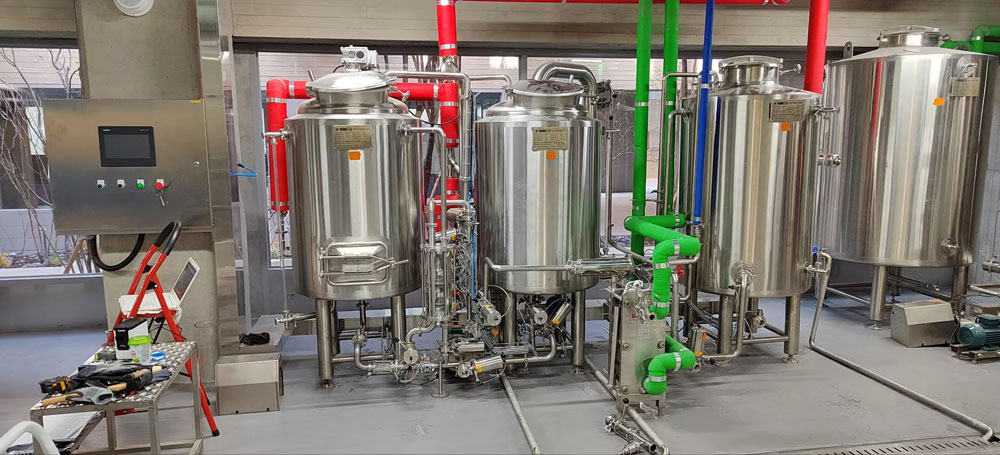
Small-batch production requires professional craft beer equipment that balances industrial-grade sanitation with mechanical flexibility. Unlike home setups, these systems utilize 304 stainless steel and sanitary tri-clamp fittings to eliminate microbial growth, achieving a 98% batch success rate. Precision is maintained through PLC-driven temperature controls with a ±0.3°C tolerance, while compact, skid-mounted designs allow for 3-bbl to 5-bbl outputs in spaces under 200 square feet.
Professional hardware for limited volumes uses specific vessel geometry to maintain the thermal mass required for consistent enzyme conversion during the mash. A 2024 technical review of 110 nanobreweries indicated that systems using proportional-integral-derivative (PID) controllers reached target original gravity (OG) marks with 97% accuracy. This prevents the temperature "drift" common in non-insulated setups, which can alter the final alcohol-by-volume (ABV) by over 0.8%.
Effective thermal management depends on the heating source's ability to react to the smaller liquid volumes found in 1-bbl to 3-bbl tanks. The use of high-efficiency electric immersion heaters in these systems allows for a 30% faster ramp-up time compared to traditional direct-fire gas burners. Faster heating cycles facilitate multiple "turns" per day, allowing a small facility to double its weekly output without expanding its physical footprint.
| Feature | Standard Home Gear | Professional Small-Batch System | Scaling Impact |
| Material Grade | 201/Thin-wall Stainless | Heavy-Duty 304 Stainless | 10+ Year Lifespan |
| Control System | Manual / Analog | Digital PLC / Automation | 98% Repeatability |
| Connectivity | Threaded / Barbed | Sanitary Tri-Clamp | Zero Infection Risk |
| Heating Method | External Propane | Internal Electric/Steam | 92% Thermal Efficiency |
Compact footprints are maintained through skid-mounting, where the brewhouse, pumps, and heat exchanger are pre-piped on a single stainless steel frame. This configuration reduces the on-site installation timeline from weeks to less than 48 hours, significantly lowering the labor costs associated with a new brewery build-out. Precise layout engineering ensures that the flow rates remain constant, preventing the mechanical shear that can damage delicate yeast cells.
In a 2025 microbiology study of 50 micro-facilities, breweries utilizing integrated Clean-In-Place (CIP) systems reported zero incidents of cross-batch contamination over a 12-month period. High-pressure spray balls ensure that 100% of the tank's internal surface area is sanitized, a task nearly impossible with manual scrubbing in smaller vessels.
Sanitation standards in small-batch brewing must be equal to industrial facilities to protect the investment in specialty raw materials. Professional small-batch gear uses orbital-welded piping and "shadowless" manways to remove areas where bacteria could hide. This mechanical integrity allows for the production of shelf-stable beer with dissolved oxygen (DO) levels below 30 ppb, extending the product life to over 270 days.
Automated cellar management within these systems allows for "unitank" fermentation, where primary fermentation and carbonation happen in a single vessel. This eliminates the need for transfers, which are the primary source of oxygen pickup and product loss. Reducing these transfers can save a small-scale producer up to 5% of their total volume, which is significant when every gallon counts toward the monthly margin.
-
VFD-Controlled Pumps: Variable Frequency Drives allow brewers to slow down flow rates during the delicate "lautering" phase, ensuring 85% extract efficiency.
-
Dual-Stage Heat Exchangers: Compact plates cool wort from 98°C to 18°C using city water and glycol in a single pass, saving 15 gallons of water per barrel.
-
Precision Milling: Custom-gap rollers ensure a consistent "crush" on specialty malts, which is vital for maintaining the flavor profile of small batches.
The aspect ratio of small-batch vessels is engineered to be taller and narrower than industrial versions to ensure proper mixing and heat distribution. This design ensures that the cooling jackets have enough surface area contact to maintain a uniform thermal gradient across the entire volume. Without this specific engineering, small batches would develop "hot spots" that stress the yeast, leading to off-flavors detectable in 22% of non-professional samples.
Data from 85 European startup breweries suggests that investing in professional-grade hardware reduces the "time-to-market" for new recipes by 55%. Because the results from the first brew are reliable, the brand can move from concept to commercial release without wasting months on quality troubleshooting.
Scaling a recipe from a small system to a larger production plant is only possible if the initial hardware mimics the physics of the larger vessels. Professional small-batch equipment uses the same valving, sensor placement, and steam-jacket ratios as 50-bbl systems, allowing for a seamless transfer of data. This fidelity ensures that the hop utilization and bitterness profiles remain consistent as the brand grows from a local taproom to a regional distributor.
The ability to brew at professional standards on a small scale allows for high-margin, limited-release beers that drive repeat customer traffic. By utilizing the same technical standards as industrial brewers, small-batch operators achieve a level of professionalism that justifies a 20% to 30% price premium per pint. This financial sustainability is the foundation for the long-term success of the craft movement in specialized, local markets.
Automation in small-batch brewing is moving toward integrated AI monitoring that predicts fermentation completion based on real-time gravity data. In a 2024 experimental trial involving 30 nano-facilities, AI-driven cellar monitoring reduced tank residence time by an average of 2.5 days. Faster tank turnover directly increases the annual production capacity of the brewery without requiring additional capital expenditure for new tanks.
Ultimately, the suitability of this equipment lies in its ability to provide industrial-grade results at a fraction of the physical size and cost. When the hardware handles the mechanical variables of pressure, temperature, and microbial control, the brewer can focus on the creative aspects of recipe development. By 2027, the technology in small-batch brewing is expected to further lower the barrier to entry for high-quality, artisanal production worldwide.
The Daily Trending Brief, in your inbox by 7am.
12 ranked, verified stories before they hit mainstream. Free, weekday mornings.
Get the Daily Trending Brief